The GPT Moment for Tabular Data: Understanding the Nature Breakthrough in Tabular AI
Remember the first time you typed a question into ChatGPT and got a real answer? No setup, no specialist. You just typed, and it worked. Now imagine that same moment for predicting revenue or customer churn. A January 2025 Nature paper describes exactly that breakthrough. This research can be dense for non-researchers, so we've created this 101-style breakdown to explain why it matters for the modern enterprise.
Why Tabular Data Finally Has Its Foundation Model Moment
Most Operational business decision, from revenue forecasting to churn prediction and fraud detection, run on structured tabular data. For the better part of two decades, making predictions on that data meant building a new model from scratch every single time. A paper published in Nature in January 2025 changes that.
What is tabular data? Tabular data is structured information organised in rows and columns, the records living in your ERP, CRM, your data warehouse and your spreadsheets. It is the primary language of business operations, and it drives the prediction tasks that generate measurable business impact.
Remember the first time you typed a question into ChatGPT and got a real answer?
No setup. No training data. No specialist. You just typed, and it worked.
That moment rewired how millions of people thought about AI. Not because the technology was new, but because for the first time, it was accessible. One model, any question, instant result.
Now imagine that same moment, but instead of generating text, the model is predicting your next quarter's revenue. Or flagging which customers are about to churn. Or scoring credit risk on a portfolio you built last week.
A paper published in Nature in January 2025 describes exactly that breakthrough. For the better part of two decades, making predictions on structured data meant building a new model from scratch every single time. This research introduces a tabular foundation model (TFM) that learns from your table the way GPT learns from your prompt: you give it context, and it predicts.
Structured data may have just had its foundation model moment.
This research can be dense for non-researchers, so we've created this 101-style breakdown to explain why it matters for the modern enterprise.
How the Model Learns to Learn?
In the pre-foundation era, AI systems were set in stone. Each new task, like predicting customer churn, required training a dedicated model on a specific dataset, a process that often took weeks once data preparation and iteration were factored in.
The Nature paper introduces a new paradigm: Instead of training a new model for every problem, one foundation model uses your table as "context" and makes predictions in a single step.
Three key shifts:
The Prompting Revolution: Much like you can give an LLM a few sentences to set its tone, you can now provide a TFM with a few rows of a table as "context." The model does the rest. No separate training needed. Imagine a TFM as a student who walks into the exam, reads the first 10 examples on the page, and instantly figures out the pattern for the 11th.
Works Across Diverse Data Schemas: The model generalises across different table structures without needing task-specific architecture changes. It handles numerical and categorical columns flexibly, reducing (but not eliminating) the feature engineering burden. Domain-specific preprocessing, such as extracting geographic signals from postal codes or cyclical patterns from timestamps, still improves performance.
Broad Generalisation: Pre-training on millions of synthetic tables gives the model exposure to a wide range of data structures and statistical relationships, enabling it to transfer learned patterns to new, unseen datasets with minimal task-specific adaptation.
What is Synthetic Data? Synthetic data is data artificially created to mimic real-world data, reproducing its structure, relationships, and constraints using statistical methods, simulations, or modern generative models. It reflects key limitations of tabular datasets, which are often scarce, sensitive, messy, or imbalanced, and frequently restricted by privacy and regulatory constraints. By producing realistic but non-identifying datasets, it enables scalable training, safer data sharing, and improved coverage of rare but critical edge cases
How Tabular AI Challenges XGBoost and CatBoost on Small Data?
The quantitative evidence in the Nature study suggests that big data is no longer the only route to strong predictive performance.
The Small Data Advantage: The model excels on datasets with fewer than 10,000 rows, exactly where high-margin business decisions (niche markets, premium segments, specialised portfolios) often live.
Beating Legacy Industry Standards: Researchers tested the Tabular Foundation Models (TFMs) against AutoGluon, XGBoost, and CatBoost (the current "gold standards" for data scientists). The TFM matched or outperformed these methods in seconds, compared to the hours usually required to tune a full AutoML pipeline.
The Performance Curve: As you add just a few more rows of "context," the model’s error rate drops significantly faster than traditional methods. It learns your specific business logic almost instantly.
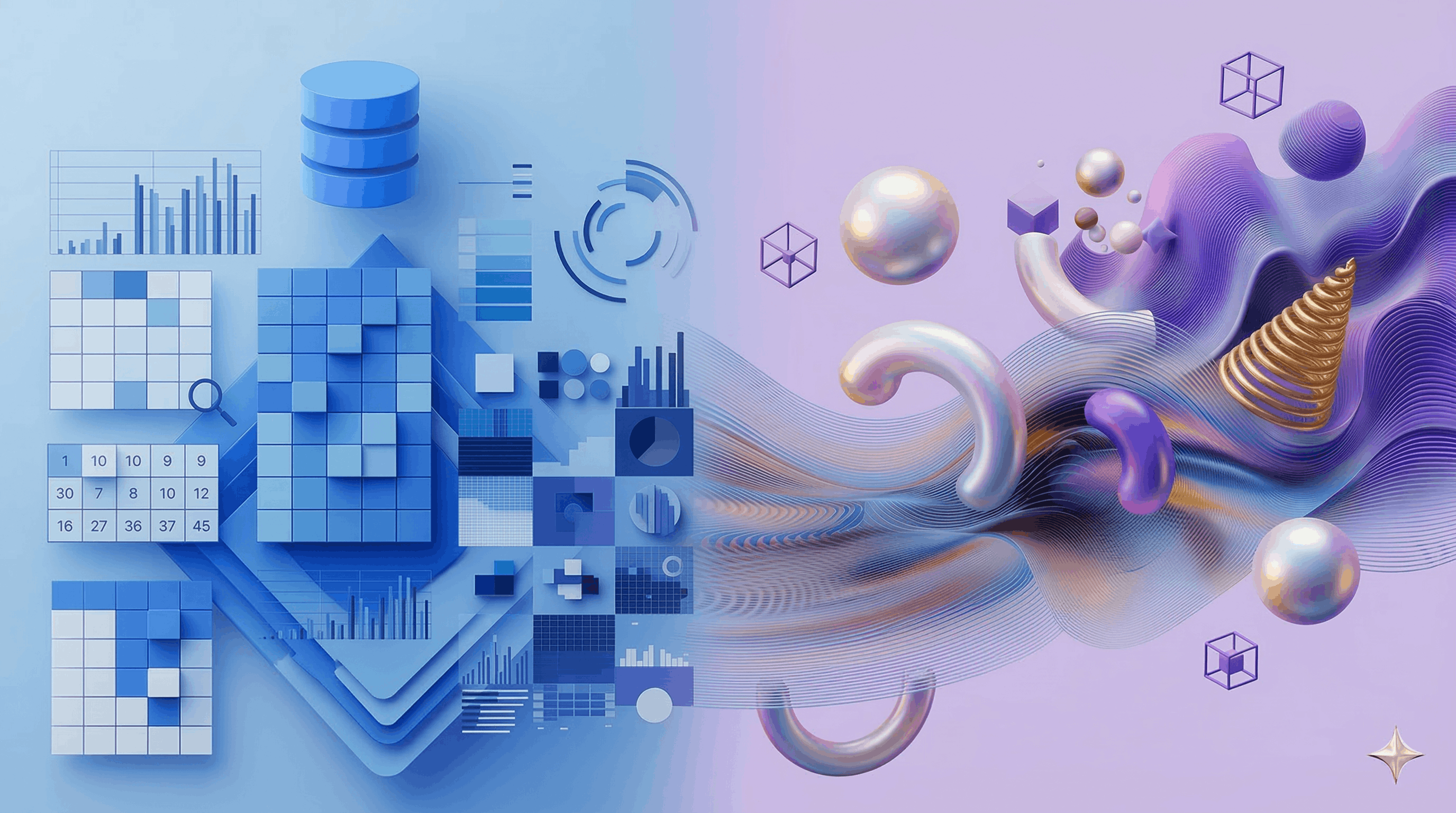
Two fundamentally different ways of learning from tabular data
There are now two emerging paradigms for learning from tabular data. Classical approaches train a dedicated model for each dataset, relying entirely on the labeled examples available for that specific task.
In contrast, tabular foundation models are pretrained once on millions of synthetic data, learning a generalisable prediction strategy that can be applied to new problems with little or no task-specific retraining.
Foundation models aren’t replacing classical methods everywhere, yet. They shine on small-to-medium datasets with limited labeled data, where synthetic pretraining can fill the gaps real examples leave behind. Think of them like early LLMs: initially weak, but rapidly growing in power as their context windows expand. On larger datasets, classical approaches still hold the edge, but the balance is shifting fast.
Feature
Traditional SOTA (AutoGluon/XGBoost)
Tabular Foundation Model (TFM)
Learning Paradigm
Task‑specific training and tuning for each new dataset.
Pretrained once on millions of synthetic tasks, then applied via in-context learning.
Primary Performance Regime
Strong performance across dataset sizes, especially with sufficient labeled data.
Demonstrated superior performance on small-to-medium datasets (up to ~10k samples).
Inference Workflow
Train → predict cycle for every task.
Single prediction step using training data as context (no retraining).
Cold-Start Capability
Limited. Performance degrades when labeled data is scarce.
Strong performance in low-data settings via synthetic pretraining.
Computational Tradeoff
Lower upfront cost but repeated training cost for each task.
High upfront pretraining cost, with decreasing marginal cost across use cases.
Scalability
Efficient for large datasets.
Currently limited by memory and compute scaling with dataset size.
Strategic Outcome: Implementing the "Predictive Layer"
Instead of building isolated models, companies can now implement a Predictive Layer, a shared prediction engine for every line of the P&L (Profit & loss statement). Use cases span every data-driven function in the enterprise:
Secure recurring revenue by deploying robust churn prediction models
Preserve capital with a fraud detection API for real-time transaction scoring
Optimise margins with supply chain predictive analytics to minimise inventory waste and free up working capital.
Increase revenue with accurate sales forecasting
reduce inventory costs with demand forecasting
This predictive platform layer unlocks three enterprise wins:
Reduces per-task model training by leveraging a single pre-trained backbone, though pretraining remains computationally intensive.
Let companies build predictive projects on small or specialised datasets that were previously too limited to justify an AI project and even enable personalised models tailored to individual customers, products, or segments.
Broader Applicability: Supports multiple use cases across the enterprise, but reducing scattered evaluation, monitoring, and governance to a single endpoint.
A new Momentum for Predictive AI
TFMs have moved from the lab to the Enterprise. While Generative AI handles the "creative" side of your business, TFMs are ready to revolutionise the Predictive Layer.
For small datasets, researchers used to rely on data augmentation or clever statistical tricks, but foundation models have solved the problem, learning from limited examples in a way that generalises far beyond what was previously possible.
At Neuralk, our in-house research team has taken these foundations and built them into an enterprise-ready platform designed to do exactly that.
The strategic question is no longer "do we have enough data," but rather: which table do we point the engine at next and which decision do we want it to inform?
At Neuralk AI, we build tabular foundation models for structured data prediction. We work with enterprises in finance, industry, and beyond to deploy predictive AI that delivers measurable results on the data that actually runs their business. If you're exploring how TFMs can fit into your AI strategy, get in touch.