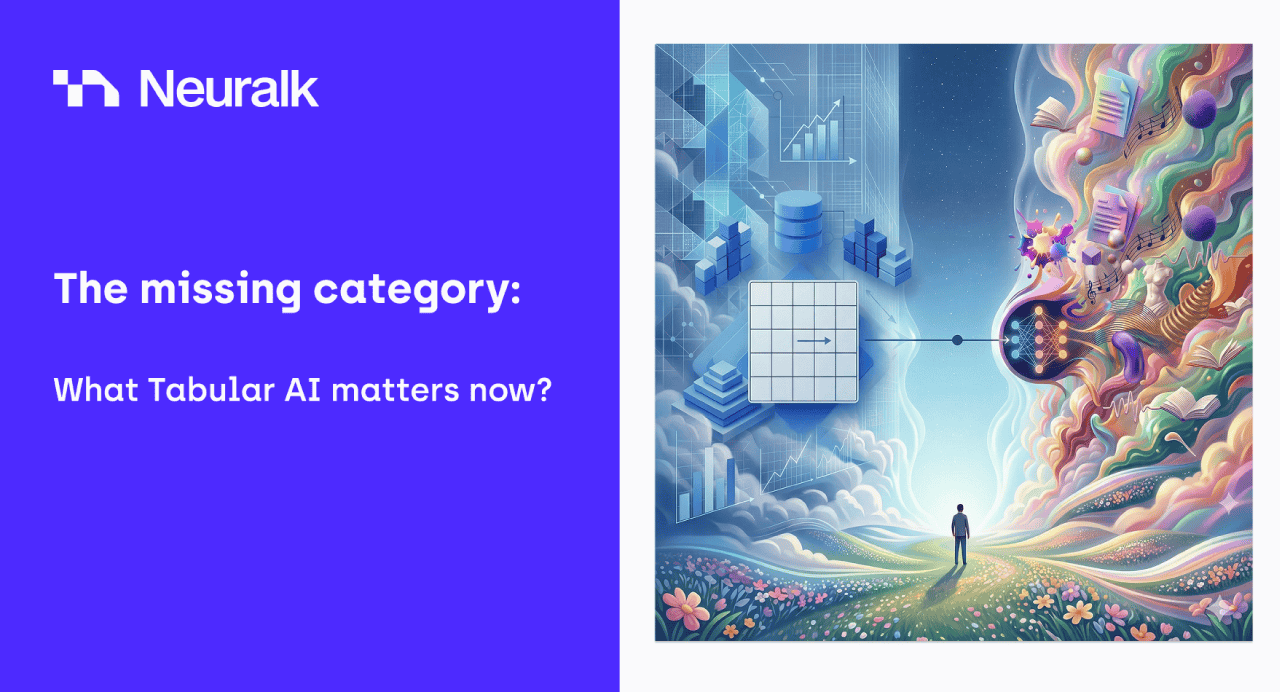
The missing category: What Tabular AI matters now?
Most enterprise AI budgets flow into Generative AI. But the use cases that show up on the Profit & Loss Account (e.g. fraud detection, churn prediction, demand forecasting, etc.) run on structured tabular data that LLMs weren't designed for. Legacy Machine Learning pipelines work but can get expensive and harder to manage as use cases grow. Tabular AI is the platform layer that's been missing from the stack.
Evidence shows that enterprise AI investment has accelerated over the last decade, maintained by consistent double-digit growth.
In recent years, Generative AI has dominated new spending growth with companies expected to increase spending in this area by nearly 60% annually [1].
However, a significant value gap has emerged: while budgets flow toward AI-optimised infrastructure, orchestration layers, copilots and conversational interfaces, the most measurable financial impact remains concentrated in operational and predictive domains [2][3]. BCG finds that 70% of AI's potential value is generated in core business functions such as R&D, sales and marketing, and manufacturing [2], yet only 39% of firms report any enterprise-level EBIT (Earnings Before Interest and Taxes) impact from their AI initiatives [3]. BCG states directly: "Predictive AI opened value in decision-making functions. Generative AI opened value in knowledge and content production functions" [4].
This distinction is the disconnect. Every line of your Profit & Loss account has a prediction behind it: fraud, revenue, prices, inventories, demand forecasting. These are not language tasks. They are tabular data prediction requirements.
What is tabular data? Tabular data is structured information, consisting of all the records organised in rows and columns, living in your ERP, CRM, databases, data warehouses and spreadsheets. It is the primary language of business operations and it drives the prediction tasks that generate measurable business impact.
Where Budgets Are Going vs. Where Value Is Generated
Generative AI is rapidly reshaping the Interface Layer. This includes model APIs, vector databases, prompt orchestration layers and copilots, the visible "vitrine" that dominates executive discussions [1][2].
The decisions that move the needle on revenue come from predictive analytics in core operations. Enterprises that invest here deploy high-impact use cases such as:
Secure recurring revenue by deploying robust churn prediction models
Preserve capital with a fraud detection API for real-time transaction scoring
Optimise margins with supply chain predictive analytics to minimise inventory waste and free up working capital.
Increase revenue with accurate sales forecasting
In the current financial landscape, the most significant EBIT impact does not come from experimental front-office tools, but from predictive models embedded in core risk and fraud domains [3]. In finance and insurance, predictive analytics remains the "heavy lifter," analysing transaction records to identify patterns invisible to human auditors.
McKinsey research shows that best-in-class insurers taking a domain-based approach to AI transformation are already seeing measurable results, including a 10 to 15 percent increase in premium growth and a 3 to 5 percent accuracy improvement in claims, core operational areas where precision is non-negotiable [7]
In retail, the clearest EBIT signal from AI is not in the front office, it is in the back end, where inventory decisions are made. Overstocking ties up working capital. Stockouts destroy revenue. Both are directly addressable through predictive models trained on structured operational data. McKinsey documents inventory reductions of 20 to 30 percent when ML-based demand forecasting is embedded into distribution operations [8], outcomes that are balance-sheet visible, not just operationally convenient.
Why LLMs Fall Short on Tabular Data
Companies initially viewed LLMs as the key to finally unlocking predictive analytics on their core business data. The logic seemed intuitive: if these models can reason across language, documents, and context, surely they can reason across the structured rows and columns of an ERP or CRM.
In practice, they fall short. Machine learning for tabular data operates on fundamentally different principles.
LLMs are not designed to serve as the decision-making engine for structured enterprise data. Machine learning for tabular data operates on fundamentally different principles. They are optimised for sequential language tokens, not for tabular records where the signal lives in the multidimensional interaction between variables. In a database, a missing value or a specific categorical code carries precise operational meaning. LLMs, however, treat these as vocabulary, missing the mathematical relationships that drive a business.
The risk of this mismatch is not just lower accuracy, it is the risk of introducing hallucination into critical business decisions [6]. A flawed demand forecast propagates into procurement; a miscalibrated fraud score misprices risk at scale. These errors are difficult to detect before they compound and are nearly impossible to govern systematically across dozens of concurrent use cases.
Doubling down on an LLM-first architecture for tabular data leads to prohibitive costs and compounding complexity.
The Hidden Cost of Legacy ML Infrastructure
The consequence is that structured prediction on critical business data remains where it has always been: reliant on the legacy ML architectures that preceded the LLM era.
Even after a decade, tabular modelling is defined by the dominance of gradient-boosted trees like XGBoost, LightGBM which typically sit atop hand-crafted, disconnected workflows. These methods have been highly effective but require:
Dataset-specific feature engineering
Separate training pipelines per use case
Ongoing maintenance and retraining
Monitoring and compliance infrastructure
Because these legacy systems are deeply integrated into regulated workflows and long-standing infrastructure, technical teams often default to incremental updates rather than adopting new platform paradigms.
However, this "model-by-model" approach may create significant operational complexity and hidden technical debt.
As enterprises scale AI across dozens of prediction tasks, their economics deteriorate. Each new use case introduces incremental engineering and maintenance costs.
Scalability is reaching its limit. Organisations now face a “bespoke trap”, a structural inability to add new capabilities without also increasing the total cost and complexity of the entire system.
The Missing Category: Tabular Foundation Models
Foundation models completely transformed how we process language. Over time, we evolved away from building a single, rigid tool for every individual problem. Instead, we shifted toward massive, "pre-trained" systems that already understand the fundamentals. This created a single, powerful core that can be quickly scaled to solve dozens of different challenges across the entire enterprise.
In enterprise AI, we still lack a similar core platform to process structured data at scale. Most predictive systems are still built as isolated, one-off projects rather than reusable model platforms. Tabular Foundation Models are designed to break this cycle.
Instead of building a new, custom model for every single dataset, we use a pretrained tabular model that can tackle any prediction task. It lets us move from raw data to working predictions in a fraction of the time. It fundamentally changes the economics of AI in three ways:
Faster Deployment
A Unified Playbook: Single framework replaces fragmented tools
Scalable Growth: Lowers marginal cost for deploying additional predictive workloads
This does not compete with generative AI infrastructure. It supports a more cohesive AI strategy by modernising the prediction layer underneath.
The Strategic Shift: From Niche Tool to Platform Layer
Tabular data is the primary language of the enterprise. It constitutes the vast majority of operational assets: financial records, customer transactions, inventory logs, claims data, and pricing histories. The highest-impact AI use cases identified by IDC and McKinsey are rooted in these datasets.
If foundation-model principles are applied effectively to structured data, the result is not just another modeling technique. It is a new platform layer for enterprise prediction. This aligns with the consolidation and reuse patterns that McKinsey and BCG describe as the hallmark of "AI at scale" organisations.
This makes Tabular Foundation Models strategically distinct. They represent a fundamental replacement path for legacy pipelines, transforming AI from a collection of niche projects into a scalable, industrial-grade utility.
Closing the Strategy Gap: Interface vs. Infrastructure
Enterprise AI budgets will continue to prioritise generative AI applications and platforms, a trend well supported by market forecasts. However, long-term economic leverage still depends on improving the predictive systems embedded in underwriting, fraud detection, pricing, demand planning, and operations.
The structural gap is therefore not between generative AI and predictive AI. It is between:
An Interface Layerthat is being modernised at a rapid pace through Generative AI.
A Prediction Layer stagnating due to legacy structured data architectures.
Tabular Foundation Models bridge precisely that gap [9]. They allow organisations to maintain their momentum in Generative AI while simultaneously upgrading the predictive systems that drive measurable financial impact.
In this context, Tabular AI is not a niche modeling choice. It is the missing platform category in the enterprise AI stack.
At Neuralk AI, we build tabular foundation models for structured data prediction. We work with enterprises in finance, industry, and beyond to deploy predictive AI that delivers measurable results on the data that actually runs their business. If you're exploring how TFMs can fit into your AI strategy, get in touch.
References
[1] International Data Corporation - Worldwide Artificial Intelligence and Generative AI Spending Guide, 2024–2025 editions.